 PinDeck
Full disclosure before anything else: I build PinDeck, a visual feedback tool. So I have every reason to tell you that you need one.
That's exactly why I wanted to check. Before writing another line of marketing copy, I spent some time looking for real evidence. Academic research, surveys, vendor data, and a lot of forum threads where developers and designers complain to each other when nobody's selling anything.
Here's what I found, including the parts that don't flatter my own product.
- There's no good independent study that directly compares "tool" vs "no tool" for client website feedback. Most numbers you see come from vendors.
- But the underlying problem is well researched: the people reporting issues rarely give developers the information they actually need.
- The biggest risk with a tool isn't price. It's clients not using it and drifting back to WhatsApp.
- For small, quick projects with one technical client, you probably don't need a tool at all.
What research says about feedback quality
The best evidence doesn't come from web agencies. It comes from software engineering research on bug reports, which is basically the same problem: someone notices something wrong, and someone else has to fix it.
The most cited study here is "What Makes a Good Bug Report?" by Zimmermann, Bettenburg and colleagues, published in IEEE Transactions on Software Engineering. They surveyed experienced developers at Apache, Eclipse and Mozilla, and separately surveyed the people who file reports.
Their main finding: there's a mismatch between what developers need and what reporters provide. Developers rated steps to reproduce as the most helpful information, and those are also among the hardest things for reporters to supply. The authors also noted that missing information often reaches developers only after several rounds of back-and-forth.
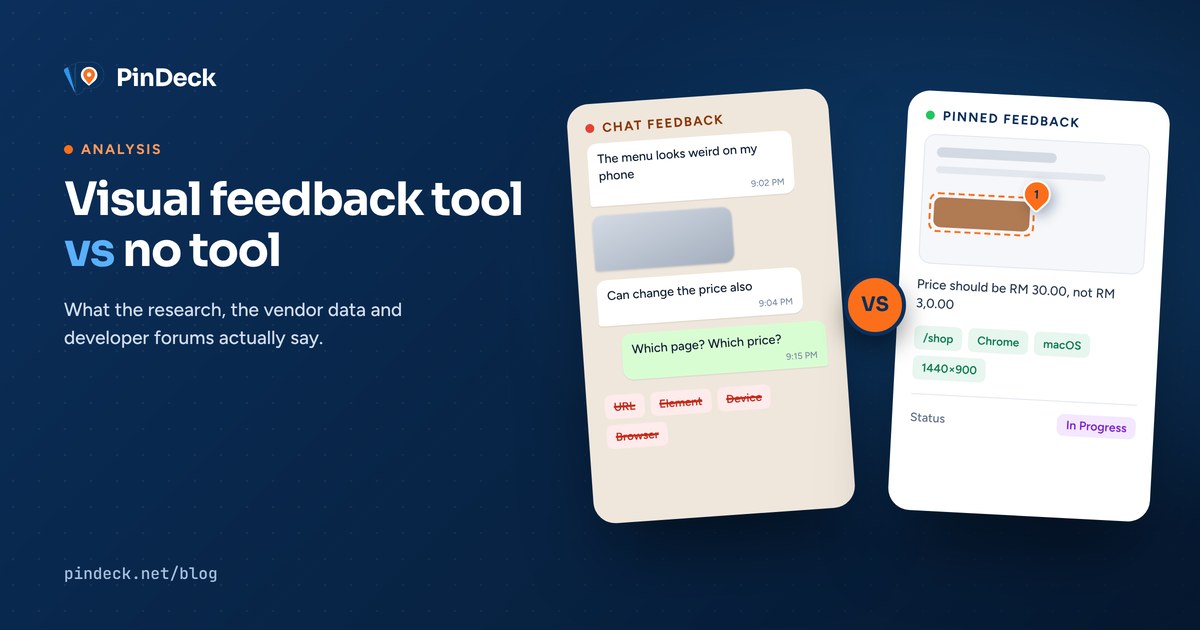
Now translate that to client work. A client isn't going to write steps to reproduce. But for a website, the equivalent is simple: which page, which element, which device and browser, and what it looked like. That's exactly what disappears in a WhatsApp message like "the menu looks weird on my phone".
The client knows what's wrong. The developer knows how to fix it. Feedback breaks down in the handover between them.
What clients actually ask for
One useful dataset comes from Feedbucket, a feedback tool that analysed over a million client-submitted feedback items. It's vendor data, and they classified items using an AI model, so treat the exact percentages loosely. The pattern is still worth seeing:
Roughly two thirds of client feedback is about text and visuals, not bugs. That matters, because these are exactly the requests where location is everything. "Change the price" is easy. Knowing which price, on which page, is the part that eats your time.
The channel problem
Most client feedback still arrives through whatever channel the client already uses. A 2016 survey of 931 web and design professionals by Usersnap found email was still the number one client communication tool, and 52.3% named unclear client communication as a major frustration. Only scope creep ranked higher, at 56.6%. The survey is old and run by a vendor, but nobody I talk to thinks the situation has improved much.
Here in Malaysia, the default channel isn't even email. It's WhatsApp. DataReportal figures reported by Statista put WhatsApp at 89.3% penetration among Malaysian internet users in 2023. Your client is already there, already comfortable, and already typing at 11pm.
WhatsApp is genuinely great for some things: quick decisions, "can we jump on a call", or "yes, approved". The trouble starts when it becomes the bug tracker.
The hidden cost: interruptions
There's another cost that rarely shows up in agency spreadsheets. Every chat message is an interruption.
Gloria Mark and colleagues at UC Irvine studied this in "The Cost of Interrupted Work: More Speed and Stress". The surprising result: interrupted people actually finished tasks faster. But they paid for it with significantly higher stress, frustration, time pressure and effort. In earlier field work Mark described in a Fast Company interview, interrupted work took an average of 23 minutes and 15 seconds to get back to.
I don't want to overstate this. A tool doesn't stop clients from having opinions. But a tool can change when you deal with them. A pin waits on a board until you're ready. A WhatsApp message buzzes on your phone during dinner and stays in your head until you answer.
What vendors claim (with a pinch of salt)
Every feedback tool has impressive numbers. Here are a few, mostly so you can see how they're measured:
| Claim | Source | How it was measured |
|---|---|---|
| 93% of users report reduced time to delivery | BugHerd | Self-reported by existing customers |
| Time spent reconciling client feedback reduced by 50% | BugHerd case study | One agency (Redback Solutions) |
| Client feedback response up to 80% faster | Pixelstorm case study | One agency, "up to" |
None of these are lies. They're also not studies. Surveys of happy customers tell you the tool works for people who kept using it. They don't tell you about the clients who ignored it. I'd treat vendor numbers, including any I publish for PinDeck, as a best case.
What developers say when nobody's selling
Forums are more honest, and they mostly agree on the problem.
In one Reddit thread (archived snapshot), a designer described sending work over email and WhatsApp and getting feedback back in multiple places, with no clear version history, approvals that weren't really final, and feedback without context. The replies were telling. One person forces clients to comment directly on the design file. Another suggested centralising everything but admitted clients may still text, so you politely redirect them. A third said no single tool fits every client, and some corporate clients aren't even allowed to use certain apps.
On Indie Hackers, a freelance developer building a feedback tool called Pinly described talking to 10+ agencies and hearing the same thing: feedback comes from emails, WhatsApp, screenshots and voice messages, and nothing is actionable. Another developer on Reddit put it more bluntly: a 9pm WhatsApp message saying the menu "looks weird" on a phone, with no URL, no screenshot and no device.
And the skeptical side is real too:
- Adoption. A recurring complaint about every tool in this space is clients who don't install the extension or skip the extra step, and quietly go back to email. Even happy BugHerd reviewers on G2 mention that some clients need guidance the first time.
- Noise. Making feedback easy also makes it easy to send duplicates and design opinions dressed up as bugs.
- Technical clients. One tool review put it nicely: if your clients are technical, you don't need this kind of tool.
Side by side
Putting it all together, here's how I'd honestly compare the two approaches:
| Chat & email (no tool) | Visual feedback tool | |
|---|---|---|
| Client effort to start | None. They already use it. | Small. Install, log in, learn to pin. |
| Which page and element | Often missing, needs a follow-up | Captured by the pin |
| Browser, device, screen size | Rarely included | Captured automatically |
| Tracking what's done | Manual, buried in chat history | Status on a board |
| Client sign-off | "OK can" somewhere in a thread | Client closes the item |
| Interruptions | Every message is a notification | Batched, handled when you choose |
| Quick decisions and approvals | Excellent | Overkill |
| Reviewing on a phone | Natural | Depends on the tool |
| Cost | Free | Monthly or per project |
Chat wins on convenience. A tool wins on context and tracking. Which matters more depends on how much feedback you get.
Run your own numbers
Since there's no reliable universal number, here's a small calculator instead. The defaults are my own rough guesses from client projects, not research. Change them to match yours.
If the saving per project is smaller than what the tool costs you per project, don't buy the tool. That's a perfectly reasonable outcome.
When you don't need a tool
Based on all of the above, I'd skip a visual feedback tool when:
- The project is small, with maybe ten or fewer change requests in total.
- Your client is technical and already writes clear, specific feedback.
- The client only ever reviews on a phone, and your tool doesn't support that well.
- It's a one-off fix, not a build with review rounds.
And I'd seriously consider one when you're running several projects at once, dealing with more than one person on the client side, or regularly asking "which page?" more than twice a week.
If you use one, make clients actually use it
Since adoption is the real failure point, this is what has worked for me:
- Show it in the kickoff call. A two-minute live demo beats any onboarding email. Pin one thing yourself while they watch.
- Keep WhatsApp for decisions, not changes. Tell the client upfront: approvals and urgent stuff on chat, anything you want changed on the site goes in as a pin.
- Redirect kindly, every time. Something like: "Thanks! Could you drop that as a pin on the page so I don't miss it?" It feels awkward the first two times, then it becomes the habit.
- Log it yourself when they don't. If a request still arrives on chat, add it to the board yourself. One list is the goal, even if you're the one typing.
My take
The evidence doesn't prove that a visual feedback tool saves every team X hours. Anyone telling you that is selling something (yes, I see the irony).
What the evidence does show is that the gap between what clients report and what developers need is real, well documented, and expensive in small invisible ways. A tool is one way to close that gap. A disciplined process with chat and a shared checklist is another.
If you're curious what the tool route looks like, PinDeck has a 30-day free trial with no card. Try it on one real project, run the calculator above with your actual numbers afterwards, and decide from there.
Sources
- Zimmermann, Premraj, Bettenburg et al. What Makes a Good Bug Report? IEEE Transactions on Software Engineering, 2010.
- Mark, Gudith, Klocke. The Cost of Interrupted Work: More Speed and Stress. CHI 2008.
- Fast Company. Interview with Gloria Mark on the cost of task switching.
- Feedbucket. Client Website Feedback Analysis, 2025 (vendor data).
- Usersnap. State of Client Collaboration survey summary, 2016 (vendor survey).
- Statista / DataReportal. Most used social media platforms in Malaysia.
- BugHerd. Homepage customer survey figures and Redback Solutions case study (vendor data).
- Digital Agency Network. Pixelstorm case study.
- Reddit thread snapshot: How do you actually keep client feedback organized?
- Indie Hackers: Pinly product updates.
- Reddit post snapshot: developer on revision feedback from non-technical clients.