 PinDeck
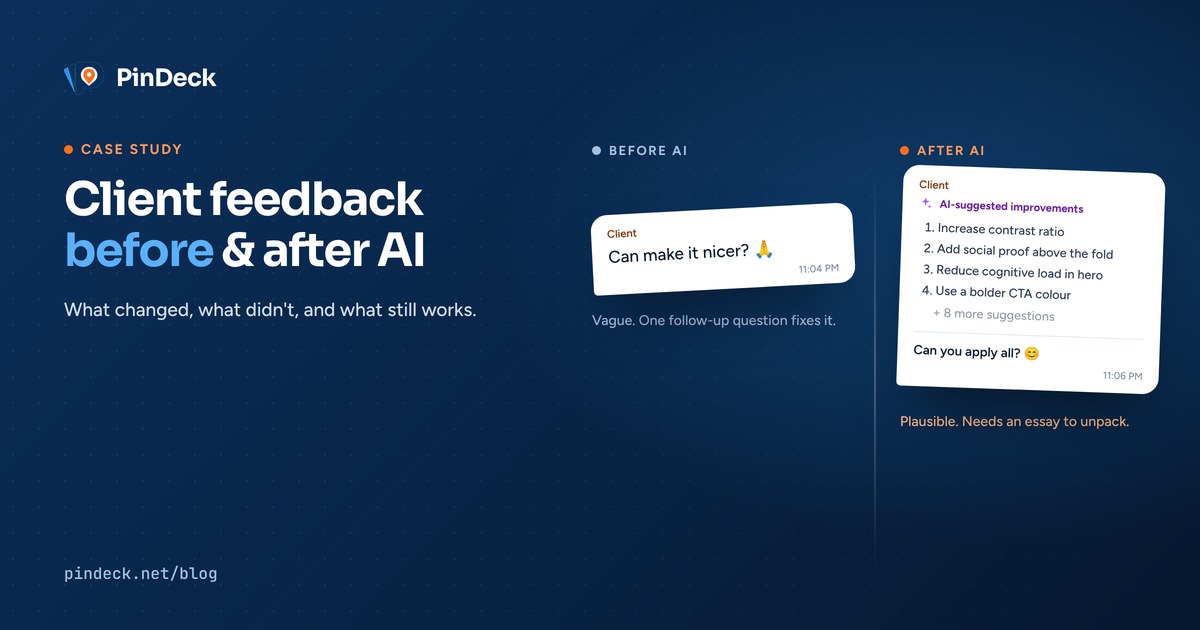
Picture this message from a client: a numbered list of twelve "improvements" to a homepage. Increase contrast, add social proof above the fold, reduce cognitive load in the hero. Every point sounds reasonable. A few of them contradict the brand guide the same client approved a month ago.
At the bottom: "ChatGPT suggested these, can you apply?"
If you design or build websites, there's a good chance you've had a version of this already. I wanted to know how common it is, and whether AI has made client feedback better or worse. The answer turned out to be both, and the most useful lessons came from places I didn't expect.
- Before AI, the main problem was vague feedback: "make it pop", "something feels off".
- After AI, a new problem appeared: plausible feedback that sounds expert but ignores context.
- AI also makes it faster to produce work from a bad brief, which can increase revisions instead of reducing them.
- The fundamentals of good feedback didn't change. If anything, AI makes them more important.
Before AI: vague, scattered, and human
Client feedback was never easy. In a 2016 Usersnap survey of 931 web professionals, 52.3% named unclear client communication as a major frustration. Software research found the same pattern years earlier: people reporting problems rarely include what developers actually need.
The classic pre-AI feedback looked like this: short, emotional and missing context. "Can make it nicer?" "Something's off with the colours." And when clients wanted a second opinion, they asked whoever was nearby. As one designer joked in the thread below, it used to be the niece in art school or the spouse with "great taste".
Annoying, but manageable. Vague feedback is obviously vague. You ask a follow-up question and move on.
Case study 1: "Can you follow the AI version instead?"
In late 2025, a graphic designer posted on r/GraphicDesigning (archived snapshot) that more and more clients were taking the work they delivered, running it through AI, and asking them to follow the AI-generated version. Not small tweaks. Changes that overrode typography, layout and brand reasoning. The designer said the frustration wasn't really the AI. It was clients who now "suddenly think they're art directors".
The thread got around 50 replies. What I found most useful is that almost nobody said "just refuse". The responses fell into a few clear strategies:
| Strategy | What designers suggested |
|---|---|
| Reframe it | Clients without design training have always existed. AI is just the newest version of the niece with an opinion. |
| Put it in the contract | Add a clause about AI-generated feedback, or raise it on the first call, before it becomes a fight. |
| Price it as scope | Treat "redo it like the AI version" as new work after approval, and quote it as such. |
| Defend with reasons | Explain each design decision clearly. The outcome depends on whether the client trusts your judgement. |
| Accept it, at a price | Some take the work only at higher rates, or when nothing better is available. |
This isn't just a graphic design thing. Business of Home reported in January 2026 that interior designers are seeing the same: clients photographing their rooms and asking ChatGPT to style them. The article notes there are no surveys on this yet, only anecdotes. It also makes a good point: because chatbots answer confidently, and give different answers depending on how a question is phrased, it's hard to push back on them.
Why AI feedback is harder to deal with
Michael Buckley put it neatly in "AI has become the third wheel": the risk isn't that clients get bad advice from AI. It's that they get plausible advice. In his words, "Plausible advice is far more dangerous because it requires analysis."
It's easy to see why. Vague feedback costs you one follow-up question. AI feedback costs you an essay explaining why "add social proof above the fold" doesn't apply to a clinic's contact page. The feedback is longer, more confident and more generic at the same time. It's often missing the exact things that matter most: which element, what problem the client actually noticed, and why it bothers them.
Case study 2: the agency where AI increased revisions
The second case is from the agency side. Arek Adeoye of Web Project Studios wrote in April 2026 about an ops manager at a mid-size digital agency who had invested in AI tools for content, reporting and scheduling. Productivity was supposed to go up. Instead, revision rounds went up, and the team was busier than before.
The cause wasn't the AI. It was the client intake form: four fields (name, deadline, budget, and one free-text box saying "tell us about the project"). AI turned that vague input into polished first drafts very quickly. They looked finished, but they were aimed at the wrong target. All the time saved on drafting went into corrections.
The fix was boring, which is why I like it. Three extra fields on the brief:
- Exclusions: what to avoid (audiences, tone, competitor territory).
- One success metric: how everyone will know it worked.
- One named approver: a person, not "the team".
To be fair, the article doesn't publish measured numbers, so treat this as a practitioner's account rather than a study. But the logic is hard to argue with: AI makes it faster to go in the wrong direction.
The perception trap
Here's the study that changed how I think about all of this. In 2025, the research nonprofit METR ran a randomized controlled trial with 16 experienced open-source developers working on 246 real tasks in their own projects.
The setting was hard for AI (big, mature codebases that the developers knew very well), and newer tools may do better. But the lesson isn't really about coding speed. It's that feeling faster and being faster can come apart. If your feedback process now involves AI on either side, don't judge it by how productive it feels. Count revision rounds per project, before and after.
The twist: AI needs good feedback too
The most interesting finding came from research on AI itself. In "Improving User Interface Generation Models from Designer Feedback", a paper reported as coming from Apple researchers, the authors argue that the usual way of training models (ratings and rankings) doesn't match how designers actually critique work.
So they asked 21 designers to give feedback the way designers normally do: commenting, sketching, and directly editing designs. That produced around 1,500 annotations. Models fine-tuned on this kind of feedback were judged better than models trained on ranking feedback, and better than every baseline tested, including GPT-5.
Read that again from a client-feedback angle. Even a machine learns more from "this specific thing, here, changed like this" than from "I prefer version B". That's exactly the difference between good and bad client feedback. It was true before AI, and it's still true now.
Before vs after, side by side
| Before AI | After AI | |
|---|---|---|
| Typical feedback | "Can make it nicer?" | A 12-point list of best practices from ChatGPT |
| Main problem | Too vague to act on | Plausible but generic, ignores context |
| Second opinion | A friend or relative with "taste" | A chatbot that sounds like an expert |
| Cost to the developer | One follow-up question | Explaining why the advice doesn't apply |
| Speed of producing work | Slow drafts, fewer wrong turns | Fast drafts, faster wrong turns if the brief is vague |
| Client confidence | Often unsure | Often very sure |
| What still works | Specific location, clear expected result, a reason, and one decision-maker | |
A playbook for client feedback in the AI era
- Talk about AI at kickoff. Say you're happy to see AI-generated ideas as references, and that you'll translate them into what fits the brand and audience. Setting this up early turns a future argument into a process.
- Ask for the problem, not the AI's solution. When a client forwards an AI redesign, ask: "What did you notice that made you want to change this?" Usually there's a real, specific concern underneath. That's the feedback you can act on.
- Anchor everything to the actual page. A list of generic AI suggestions becomes manageable once each point is attached to a specific element. Anything that can't be attached to something real is probably generic advice.
- Fix the brief before you speed up the work. Add exclusions, one success metric and one named approver. Fast drafts from a vague brief just mean faster rework.
- Use AI on your side, carefully. AI is genuinely good at turning a long WhatsApp thread into a tidy task list. Just check it against the original messages before you start working.
- Define scope for AI-driven redos. After approval, "make it like the AI version" is a new request. Put that in your contract so it's a business conversation, not a personal one.
- Measure, don't guess. Track revision rounds per project. If a new tool or process doesn't reduce them, it doesn't matter how productive it feels.
Where PinDeck fits
I build PinDeck, so take this part with that in mind. The reason I care about this topic is point 3 above. When a client's feedback is pinned to a specific element on the live page, generic advice has to become specific: which button, which section, on which screen. If a client wants to include an AI suggestion, that's fine. It just lands on the exact spot it's about, with a screenshot and browser details, and then a human decides what to do with it.
What I'm taking away from this
AI didn't break client feedback. It amplified what was already there. Vague briefs now produce wrong work faster. Clients who lacked confidence now have plenty of it, borrowed from a chatbot. And the feedback that actually works still looks exactly like it did ten years ago: a specific place, a clear expected result, a reason, and one person who can say yes.
If anything, that's reassuring. The skill that matters most hasn't changed. We just need to be more deliberate about it.
Sources
- Reddit, r/GraphicDesigning: designer on clients asking them to follow AI-generated versions (archived snapshot).
- Business of Home. Is ChatGPT influencing your client? January 2026.
- Michael Buckley, UX Collective. AI has become the third wheel.
- Arek Adeoye, Web Project Studios. The brief bottleneck, April 2026.
- METR. Measuring the Impact of Early-2025 AI on Experienced Open-Source Developer Productivity, July 2025.
- Improving User Interface Generation Models from Designer Feedback, arXiv, 2025.
- Usersnap. State of Client Collaboration survey summary, 2016.
- Zimmermann, Premraj, Bettenburg et al. What Makes a Good Bug Report? IEEE TSE, 2010.